Learner
The Learner (memorygrid_learner, MemoryGrid "Process 2") turns experience into lessons that agents can trust. A lesson reaches agents in one of three ways:
- it is mined, on a schedule or on demand, from episodic logs, task outcomes and other memory sources;
- it is injected by a human or by another agent;
- it is requested from a peer agent's Skills store or Knowledge Base (cross-agent sharing, read-only).
Mined and agent-injected lessons are enriched (why the lesson matters, evidence, priority, a suggested bin) and go to human review. Approved lessons are promoted to one of two bins:
| Bin | BinType |
Holds |
|---|---|---|
| Skills | skills_base |
Procedural knowledge, how-to patterns |
| Knowledge Base | knowledge_base |
Semantic facts, domain knowledge |
Every lesson is stored as a Markdown file, a database record and a vector embedding, and every change is a git commit.
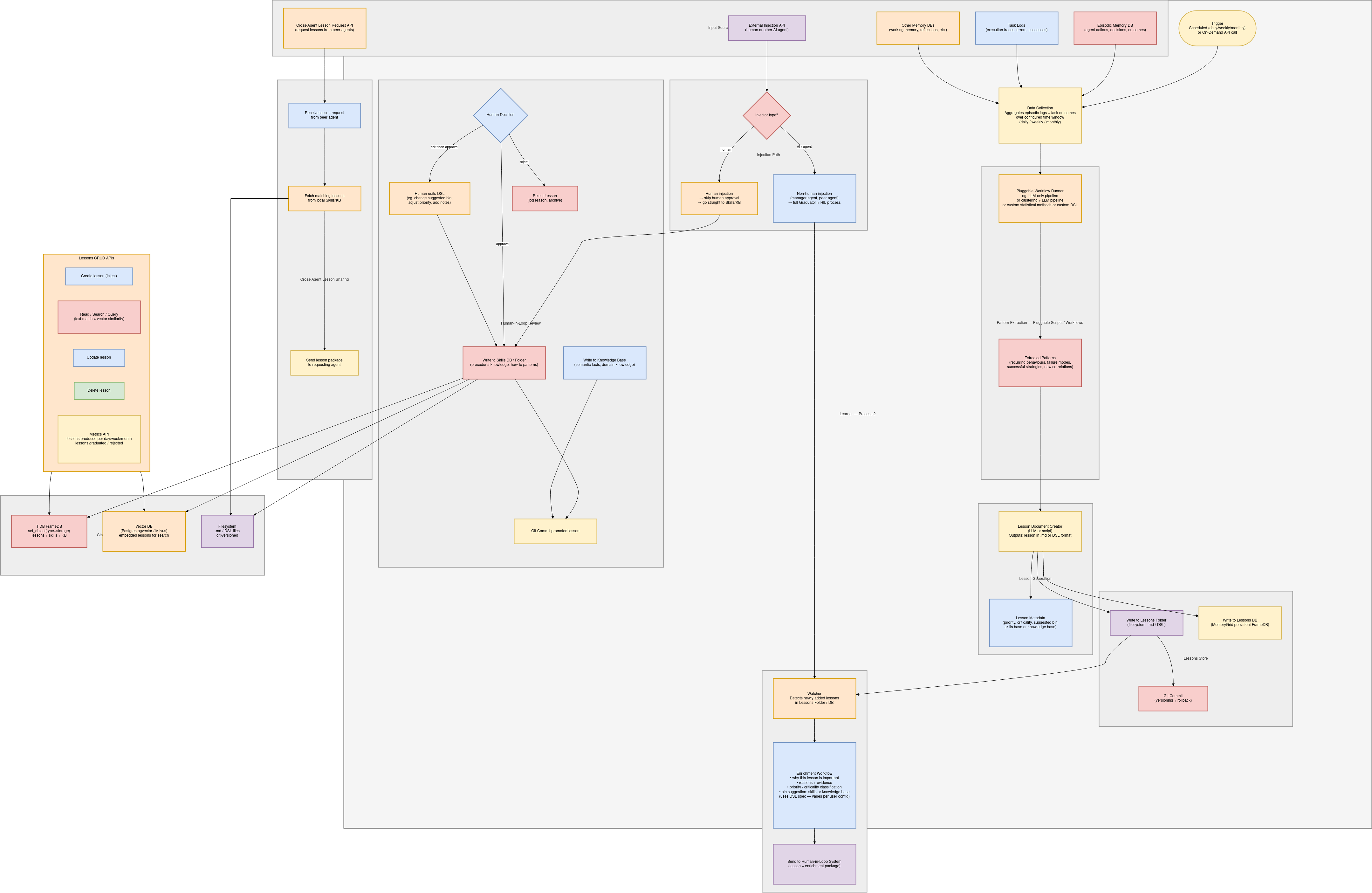
Lesson Lifecycle
            mined (pipeline)                    injected (ai_agent)              injected (human)
                  │                                    │                              │
                  ▼                                    ▼                              │
               DRAFT ──► watcher ──► enrichment ──► PENDING_REVIEW                    │
                                                       │                              │
                              human decision ◄─────────┘                              │
                     ┌───────────────┼────────────────────┐                           │
                  approve     edit_then_approve         reject                        │
                     │               │                     │                          │
                  APPROVED     EDITED_APPROVED          REJECTED ─► archive/          │
                     └───────┬───────┘                                                │
                             ▼                                                        ▼
                         PROMOTED  ◄──────────────────────────────── (skips review) APPROVED
                   skills/ or kb/  + DB + vector + git commit
| Status | Meaning |
|---|---|
draft |
Created by the pipeline (or just persisted), not yet enriched |
pending_enrichment |
Reserved for enrichment in progress |
pending_review |
Enriched and waiting for a human decision |
approved / edited_approved |
Human approved (with or without edits) |
rejected |
Rejected; file moved to archive/ and the reason logged |
promoted |
Written to the Skills store or Knowledge Base and committed |
Every transition is appended to the lesson's audit_trail.
Running the Service
Requires Python ≥ 3.10.
cd agent-memories/Learner
uv venv --python 3.11 .venv && source .venv/bin/activate     # or any Python 3.10+ venv
pip install -r requirements.txt
uvicorn memorygrid_learner.main:app --port 8000
By default it runs with no external services:
- SQLite stands in for TiDB.
- An in-memory vector index stands in for pgvector or Milvus.
- A local git repo in
./data/lessons_repoholds the lesson files. - An offline
FakeLLMClientstands in for the LLM whenANTHROPIC_API_KEYis unset.
On start-up the service:
- starts the filesystem watcher on
lessons/and the database poller; - schedules mining runs daily at 02:00, weekly on Sunday at 03:00 and monthly on day 1 at 04:00.
Configuration (environment variables)
| Variable | Default | Description |
|---|---|---|
MG_TIDB_DSN |
sqlite+aiosqlite:///./memorygrid_frame.db |
Lessons/Skills/KB object store. For TiDB use mysql+aiomysql://user:pass@host:4000/framedb |
MG_VECTOR_BACKEND |
memory |
memory, pgvector or milvus |
MG_VECTOR_DSN |
"" |
pgvector DSN or Milvus URI |
MG_VECTOR_DIM |
128 |
Embedding dimension |
MG_LESSONS_ROOT |
./data/lessons_repo |
Lesson files + git repository |
MG_WORKFLOW_STRATEGY |
statistical |
Pattern-mining strategy: statistical, llm_only, clustering_llm, custom_dsl |
MG_DEFAULT_TIME_WINDOW |
daily |
Default mining window |
ANTHROPIC_API_KEY |
unset | Enables real LLM calls (otherwise FakeLLMClient) |
MG_LLM_MODEL |
claude-sonnet-5 |
Model name for LLM calls. Set it to a model ID your account can use (e.g. claude-sonnet-5-5) |
MG_DSL_CONFIG_DIR |
./config/dsl |
Per-tenant lesson DSL schemas |
MG_TENANT_ID |
unset | Tenant whose DSL schema to load |
MG_DB_POLL_INTERVAL_SEC |
30 |
Database poll interval for new drafts |
Optional vector backends need extra packages: psycopg[binary] + pgvector (and CREATE EXTENSION vector) for pgvector, pymilvus for Milvus.
The default vector embedding is a deterministic hashed bag-of-words, not a semantic model. Vector search therefore matches on shared words. Pass your own
embedding_fntoVectorStoreClientfor semantic search (see Programmatic Use).
REST API
Inject a lesson — POST /lessons/inject/
curl -X POST http://localhost:8000/lessons/inject/ -H "Content-Type: application/json" -d '{
  "title": "Retry flaky uploads",
  "body_md": "Retry uploads up to 3 times with exponential backoff when the storage API returns 503.",
  "injector_type": "human",
  "injected_by": "alice@example.com",
  "dsl_payload": {"action": "retry_with_backoff", "instruction_template": "Retry {operation} with backoff"},
  "metadata": {"priority": "high", "criticality": 0.8, "suggested_bin": "skills_base", "tags": ["storage"]}
}'
| Field | Required | Description |
|---|---|---|
title, body_md |
Yes | Lesson title and Markdown body |
injector_type |
Yes | human or ai_agent |
injected_by |
Yes | Human or agent ID |
dsl_payload |
No | Structured payload. An action (and optional instruction_template) here lets the Incorporator apply the lesson deterministically |
metadata |
No | priority (low/medium/high/critical), criticality (0–1), suggested_bin (skills_base/knowledge_base), tags, source_pattern_ids. Default: medium priority, 0.5, knowledge_base |
Routing:
human— trusted. The lesson skips review and is promoted immediately to the bin inmetadata.suggested_bin. Response status:promoted.ai_agent— persisted as a draft, enriched, and queued for human review. Response status:pending_review, withenrichmentfilled in.
POST /lessons/ does the same as POST /lessons/inject/.
Human review
curl http://localhost:8000/lessons/review/queue           # lessons with status pending_review

curl -X POST http://localhost:8000/lessons/review/<lesson_id>/decide \
  -H "Content-Type: application/json" -d '{"decision": "approve"}'

curl -X POST http://localhost:8000/lessons/review/<lesson_id>/decide \
  -H "Content-Type: application/json" -d '{
    "decision": "edit_then_approve",
    "edits": {"title": "Retry uploads with backoff",
              "metadata": {"suggested_bin": "skills_base", "priority": "high"},
              "notes": "Verified against last week'\''s incidents"}
  }'

curl -X POST http://localhost:8000/lessons/review/<lesson_id>/decide \
  -H "Content-Type: application/json" -d '{"decision": "reject", "reject_reason": "too specific"}'
| Decision | Effect |
|---|---|
approve |
Promote to the bin in metadata.suggested_bin |
edit_then_approve |
Apply edits (title, body_md, metadata.*, notes → dsl_payload.human_notes), then promote |
reject |
Set rejected and reject_reason, move the file to archive/. The record is kept, not deleted |
Returns the updated lesson (404 if unknown).
Lessons CRUD and search
| Method & Path | Description |
|---|---|
GET /lessons/{lesson_id} |
Get a lesson |
GET /lessons/?q=<text>&status=<status>&top_k=10 |
List lessons (optionally by status). With q, lessons are filtered by text match on title/body, and bin_matches adds the best Skills/KB hits (text + vector) |
PUT /lessons/{lesson_id} |
Update title, body_md, metadata (merged); re-writes the file and commits |
DELETE /lessons/{lesson_id} |
Delete the lesson record, its vector entry and its Skills/KB entries |
Cross-agent lesson request — POST /lessons/cross-agent/request
Read-only. A peer agent asks for relevant promoted lessons:
curl -X POST http://localhost:8000/lessons/cross-agent/request -H "Content-Type: application/json" \
  -d '{"agent_id": "peer-agent-7", "query": "upload retries", "top_k": 5, "bin": "skills_base"}'
The response is {"requested_by": "peer-agent-7", "lessons": [{"lesson_id", "title", "body_md", "score", "match_type": "text" | "vector"}, ...]}. Omit bin to search both bins. Text matches score 1.0.
Mining on demand — POST /learner/trigger?time_window=daily
Runs the mining pipeline once and returns the new draft lesson. time_window is daily, weekly or monthly.
Metrics
| Method & Path | Returns |
|---|---|
GET /lessons/metrics/throughput?granularity=day |
Lessons created per day, week (ISO) or month |
GET /lessons/metrics/outcomes |
total, promoted, rejected, pending, graduation_ratio, rejection_ratio |
GET /health |
{"status": "ok"} |
The Mining Pipeline
run_learner_pipeline(time_window):
- Data collection —
DataCollectorgathers episodes, task outcomes and auxiliary records (working memory, reflections) for the window. - Pattern extraction — the configured workflow strategy returns
ExtractedPatterns. Each has apattern_type(recurring_behaviour,failure_mode,successful_strategyornew_correlation), adescription,supporting_evidence, aconfidenceand atime_window. Patterns are saved asextracted_patternobjects. - Lesson creation —
LessonDocumentCreatorrenders a lesson (Markdown +dsl_payload+ metadata). - Persist — the lesson file is written to
lessons/, its record to the database, and both are committed to git. - The watcher detects the new draft, runs enrichment, and submits it to the review queue.
Workflow strategies
| Strategy | Needs LLM | How it finds patterns |
|---|---|---|
statistical (default) |
No | Counts failure error_codes among task outcomes with status == "failure", and successful actions among episodes with outcome == "success". Anything seen at least min_occurrences (2) times becomes a failure_mode or successful_strategy pattern. Confidence = count / total |
llm_only |
Yes | Sends episodes and outcomes (in chunks of 50) to the LLM and parses a JSON list of patterns |
clustering_llm |
Yes | Embeds all records, clusters them with KMeans (default 3 clusters), and asks the LLM to summarise each cluster |
custom_dsl |
No | Runs your own Python extract(dataset) -> list[dict] in a restricted namespace (safe built-ins only; not a hard sandbox) |
Records the statistical strategy understands:
episode     = {"action": "retry_with_backoff", "outcome": "success"}
task_result = {"status": "failure", "error_code": "RATE_LIMIT"}
A custom strategy:
from memorygrid_learner.learner import workflows  # registers the built-in strategies
from memorygrid_learner.learner.workflow_runner import WorkflowRunner

script = '''
def extract(dataset):
    slow = [e for e in dataset["episodes"] if e.get("latency_ms", 0) > 2000]
    if len(slow) < 3:
        return []
    return [{"pattern_type": "new_correlation",
             "description": f"{len(slow)} slow episodes this window",
             "confidence": 0.7, "supporting_evidence": slow[:5]}]
'''
runner = WorkflowRunner("custom_dsl", script_source=script)
You can register your own strategy class with WorkflowRunner.register("name", MyStrategy). The class must subclass WorkflowStrategy and implement async run(dataset) -> list[ExtractedPattern].
Lesson creation
The service uses script mode, a deterministic renderer:
- Title — the highest-confidence pattern.
- Body — a summary, steps or facts, and evidence sections.
- Priority —
highif the average confidence is ≥ 0.75,mediumif ≥ 0.4, elselow. - Criticality — the average confidence.
- Suggested bin —
skills_baseforsuccessful_strategy/failure_mode, otherwiseknowledge_base.
LessonDocumentCreator(mode="llm", llm_client=...) renders lessons with an LLM instead.
Enrichment and the lesson DSL schema
Enrichment asks the LLM for why_important, reasons_and_evidence, priority_classification, criticality_classification and bin_suggestion, and stores them in lesson.enrichment. Enrichment and lesson creation are driven by a lesson DSL schema (required fields and sections), loaded per tenant:
<MG_DSL_CONFIG_DIR>/<MG_TENANT_ID>.json, else<MG_DSL_CONFIG_DIR>/default.json, else- the built-in default (
title,summary,priority,suggested_bin, optionaltags; sectionssummary,steps_or_facts,evidence).
{
  "version": "2.0",
  "fields": [
    {"name": "title", "type": "string"},
    {"name": "priority", "type": "enum", "enum_values": ["low", "medium", "high", "critical"]},
    {"name": "owner_team", "type": "string", "required": false}
  ],
  "required_sections": ["summary", "steps_or_facts", "evidence", "rollback"]
}
LessonDSLSchema.validate_payload(payload) returns a list of validation errors (empty if valid).
Storage
| Store | Contents |
|---|---|
Object store (TiDBFrameDBClient, table framedb_objects) |
JSON objects keyed by (obj_type, obj_id): lesson, skill, knowledge_base_entry, extracted_pattern |
Vector store (VectorStoreClient) |
Embeddings of promoted lessons, with metadata bin and title |
Filesystem (MG_LESSONS_ROOT) |
lessons/ (drafts, pending review), skills/, kb/, archive/; each lesson is <id>.md with JSON front-matter (id, title, status, metadata, enrichment) and the Markdown body |
Git (GitVersioning, same folder) |
A commit for every draft, update, promotion and archive. history(path) lists a file's commits; rollback(sha) reverts a commit non-destructively |
Promotion (SkillsStore.promote / KnowledgeBaseStore.promote):
- Moves the file from
lessons/toskills/orkb/. - Writes the
skillorknowledge_base_entryobject. - Upserts the embedding.
- Commits to git.
Feeding Experience into the Learner
The data collector's sources (EpisodicMemoryClient, TaskLogClient, MemoryDBClient) are in-process, append-only stores. They are not connected to Agentic Memory, and they return all records regardless of the time window. Feed them yourself, or replace them with clients that read your real stores. A replacement only needs an async fetch(time_window) -> list[dict] method.
from memorygrid_learner.api.deps import build_dependencies
from memorygrid_learner.learner.pipeline import run_learner_pipeline

deps = build_dependencies()

# Push experience (e.g. from Agentic Memory episodes)
for ep in mem.episodic.get_by_agent("uploader", limit=200):
    deps.data_collector.episodic_db.add({"action": ep.metadata.get("action"),
                                         "outcome": ep.outcome.value})
deps.data_collector.task_log_db.add({"status": "failure", "error_code": "RATE_LIMIT"})

lesson = await run_learner_pipeline("daily", deps.learner_deps)
A custom source:
from datetime import datetime, timedelta, timezone

class AgenticMemoryEpisodes:
    def __init__(self, mem, agent_id):
        self.mem, self.agent_id = mem, agent_id

    async def fetch(self, time_window: str) -> list[dict]:
        days = {"daily": 1, "weekly": 7, "monthly": 30}[time_window]
        since = datetime.utcnow() - timedelta(days=days)
        return [{"action": e.metadata.get("action"), "outcome": e.outcome.value, "content": e.content}
                for e in self.mem.episodic.get_by_agent(self.agent_id, limit=1000)
                if e.created_at >= since]

deps.data_collector.episodic_db = AgenticMemoryEpisodes(mem, "uploader")
Programmatic Use
All components can be used without the HTTP layer:
from memorygrid_learner.api.deps import build_dependencies
from memorygrid_learner.config import Settings
from memorygrid_learner.hil.review_service import ReviewDecision
from memorygrid_learner.learner.pipeline import run_learner_pipeline

deps = build_dependencies(Settings(lessons_root="/tmp/lessons", workflow_strategy="statistical"))

draft = await run_learner_pipeline("daily", deps.learner_deps)
enriched = await deps.enrichment_workflow.enrich(draft)
enriched = await deps.lessons_store.update_lesson(enriched, stage="draft")

promoted = await deps.review_service.decide(str(enriched.id), ReviewDecision.APPROVE)
hits = await deps.skills_store.search("rate limit", top_k=3)
To plug in a real embedding model, rebuild the vector client with your own embedding_fn before building the stores, or construct the stores directly:
from memorygrid_learner.storage.vector_client import VectorStoreClient

vector = VectorStoreClient(backend="pgvector", dsn_or_uri="postgresql://...", dim=1536,
                           embedding_fn=my_embed)
Notes and Limitations
- Review queue. The queue is in-process. The source of truth for pending reviews is the lesson
status(GET /lessons/review/queue), so restarting the service doesn't lose them. - Duplicate processing. An
ai_agent-injected lesson is briefly stored as adraftbefore it is enriched. If the database poller runs in that window, the lesson can be enriched and queued twice. - Data sources. The time window is not applied by the built-in in-memory data sources.